
Most stock rankings are built on intuition. Ours is built on forty years of peer-reviewed research.
The factors that predict stock returns have been established with extensive academic research. They're published in the Journal of Finance, the Journal of Financial Economics, and the Review of Financial Studies. Academics have spent decades identifying what actually works: which characteristics predict outperformance, which signals are noise, and which anomalies persist after publication.
We took that research and applied it systematically to 150 small to mid-cap software stocks.
The Five-Factor Model
Our ranking system scores every stock on five characteristics with documented predictive power. These five factors form the foundation of our fundamental ranking, with every stock receiving a score from 0 to 100 based on its composite profile.
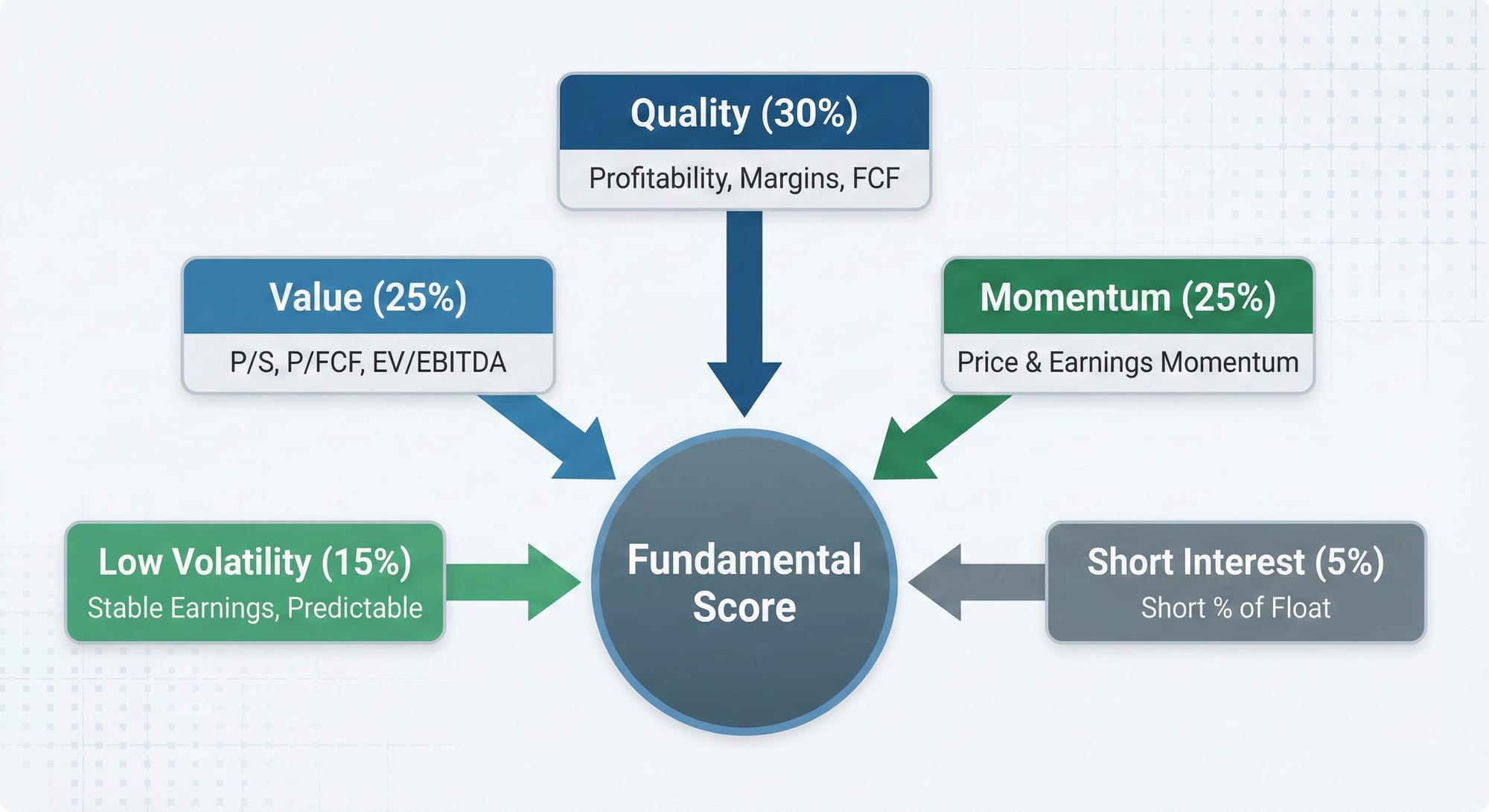
Quality (30%) — Profitable companies outperform unprofitable ones. Novy-Marx (2013) showed that gross profitability has the same power as book-to-market in predicting returns. Fama and French added profitability to their model in 2015 because the evidence was overwhelming. We measure operating margins, return on equity, free cash flow conversion, and balance sheet strength.
Value (25%) — Cheap stocks outperform expensive ones over time. Fama and French (1992, 1993) documented this across decades of data. Lakonishok, Shleifer, and Vishny (1994) showed investors systematically overpay for growth and underpay for value. We measure price-to-sales, price-to-free-cash-flow, and EV/EBITDA relative to quality.
Momentum (25%) — Stocks that have been rising tend to keep rising. Jegadeesh and Titman (1993) found that winners outperform losers by roughly 1% per month over 3-12 month horizons. Carhart (1997) made momentum the fourth factor in asset pricing models. We measure both price momentum and earnings momentum.
Low Volatility (15%) — Stable stocks outperform volatile ones on a risk-adjusted basis. This shouldn't be true according to finance theory, but Ang (2006) and Frazzini and Pedersen (2014) documented it extensively. High-volatility stocks are systematically overpriced because investors overpay for speculative upside. We favor companies with predictable businesses and stable earnings.
Short Interest (5%) — Heavily shorted stocks underperform. Boehmer, Jones, and Zhang (2008) showed that short sellers are informed traders. When sophisticated investors are betting against a stock, it's a warning sign. We penalize names with elevated short interest as a percentage of float.
These five factors form the foundation of our fundamental ranking. Every stock receives a score from 0 to 100 based on its composite factor profile.
The Timing System
A stock can score 95 on fundamentals and still be a bad investment. Price matters. We built a timing system that also answers when to act, using six components grounded in market research. The timing score runs from 0 to 100, with a score above 70 signaling favorable entry conditions.
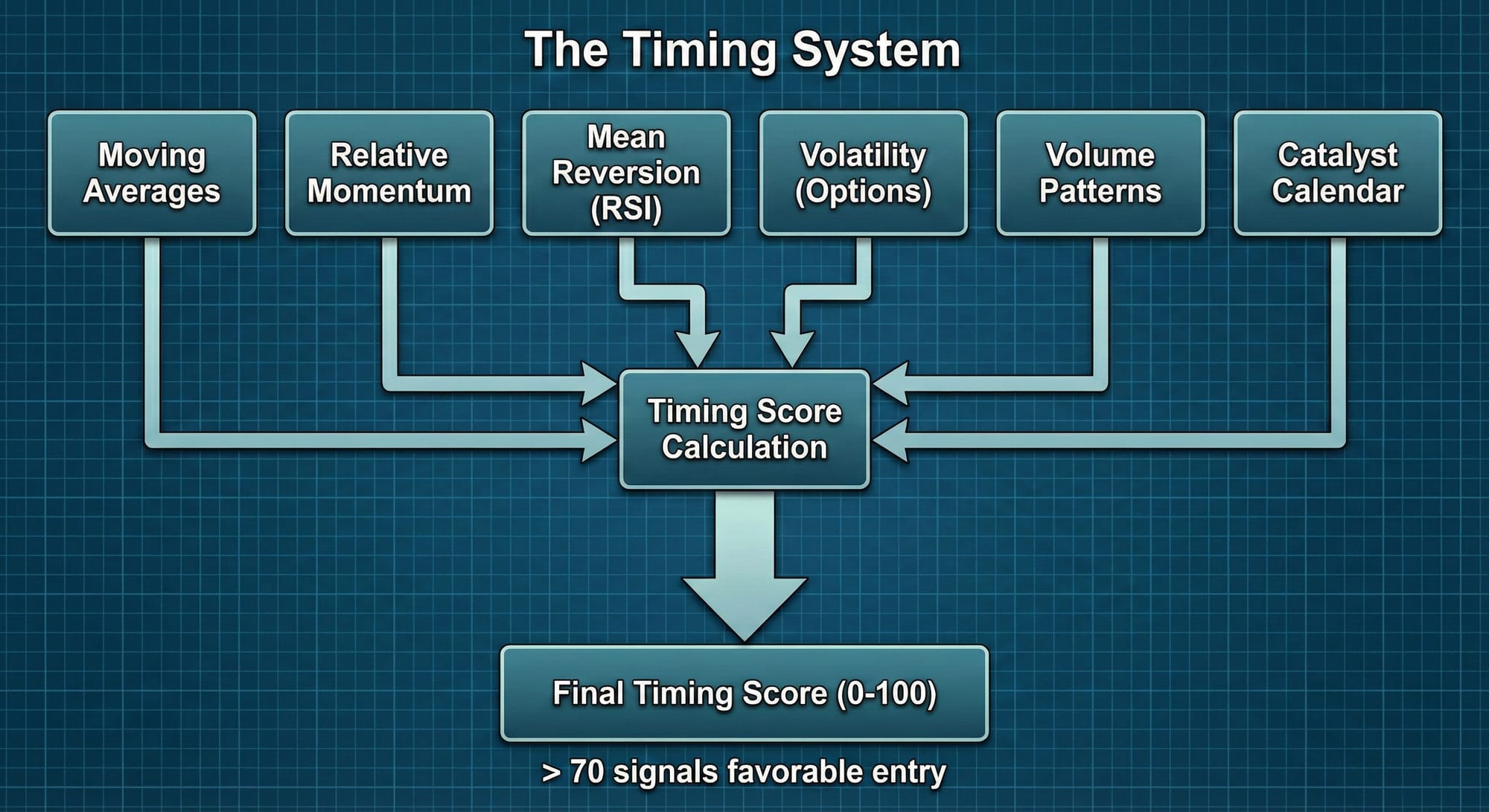
The system analyzes price position relative to moving averages, relative momentum versus sector peers, mean reversion signals (RSI), option implied volatility, volume patterns, and a catalyst calendar to determine the optimal time for entry.
The Top 10
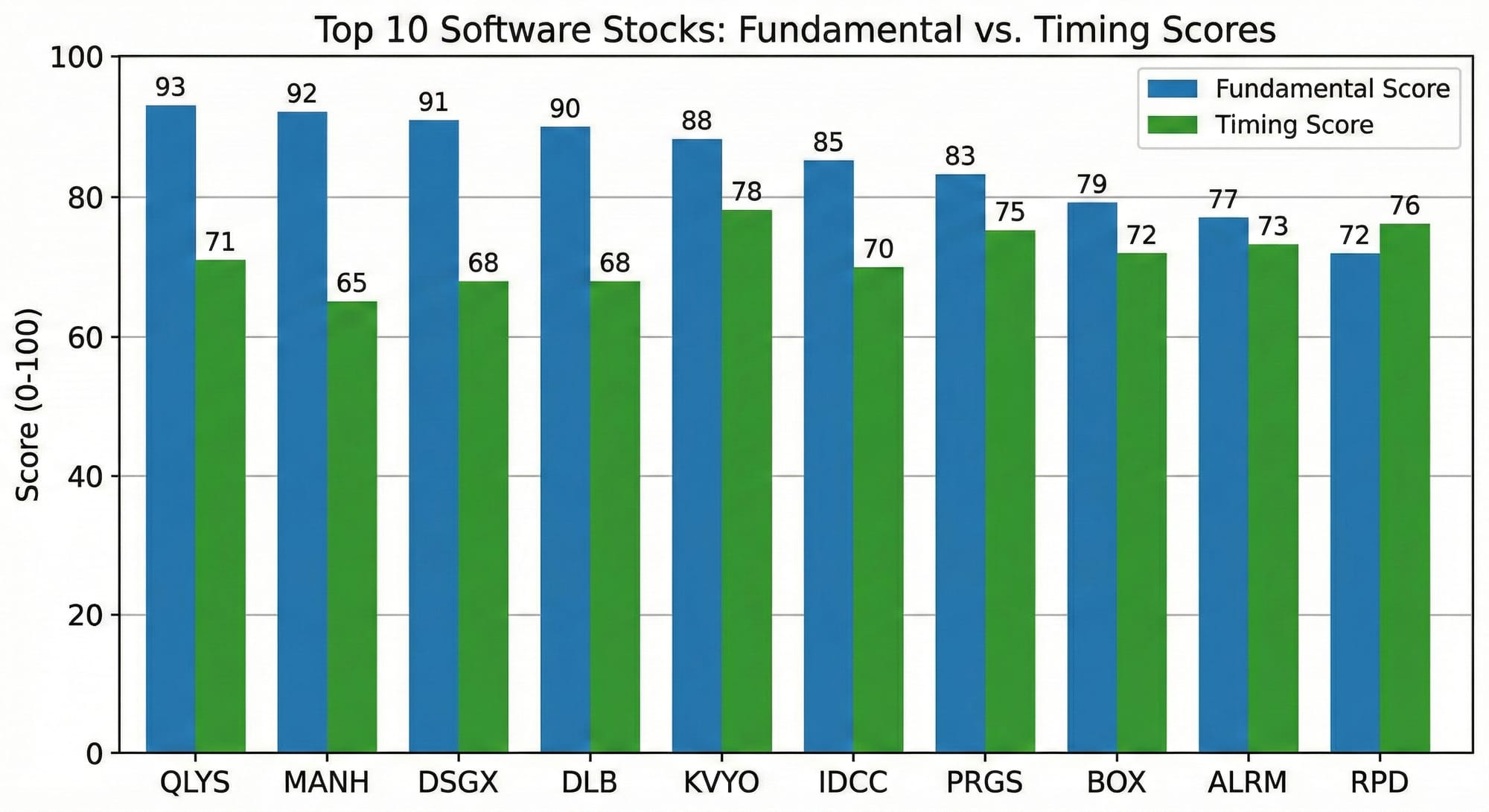
Below are the ten names where fundamental quality and entry timing align. These are the highest-ranked stocks with favorable setups right now.
1. Qualys (QLYS)
Fundamental Score: 93 | Timing Score: 71
Qualys is the highest-scoring stock in our universe because it excels on every factor. Quality: 50%+ operating margins, 20%+ free cash flow yield. Value: 8x revenue is cheap for this profitability. Low Volatility: stable, predictable vulnerability management business. Momentum: positive earnings revisions. Short Interest: minimal.
The stock just pulled back to its 50-day moving average after a post-earnings rally. This is exactly what a favorable entry looks like in a high-quality name.
2. Manhattan Associates (MANH)
Fundamental Score: 92 | Timing Score: 65
Manhattan Associates dominates supply chain software. The company delivers consistent 20%+ growth with expanding margins.
Our timing score of 65 suggests the stock is fairly valued rather than offering a discount entry. For new positions, wait for a pullback.
3. Descartes Systems (DSGX)
Fundamental Score: 91 | Timing Score: 68
Descartes operates the logistics technology network connecting shippers, carriers, and customs authorities globally. It's essential infrastructure that most investors have never heard of. High recurring revenue, sticky customers, quiet consistent execution.
Timing score approaching our 70 threshold. One of the best risk/reward setups in software for patient capital.
4. Dolby Laboratories (DLB)
Fundamental Score: 90 | Timing Score: 68
Dolby collects licensing royalties on every device with audio technology. The business model is great: 90%+ gross margins, minimal capital requirements, predictable cash flows. The company pays a 4%+ dividend funded by sustainable free cash flow and aggressively buys back stock.
Our Low Volatility factor loves this name. Timing score just below our 70 threshold. Another week of consolidation or a small dip makes this a buy.
5. Klaviyo (KVYO)
Fundamental Score: 88 | Timing Score: 78
Klaviyo is the best pure growth story in our coverage, 30%+ revenue growth with expanding margins and a Rule of 40 score above 45. The email and SMS marketing platform has become essential infrastructure for e-commerce brands.
The timing score of 78 is the highest in our universe. Six weeks of tight consolidation near the 50-day moving average. If you want growth exposure in software, this is one to consider.
6. InterDigital (IDCC)
Fundamental Score: 85 | Timing Score: 70
InterDigital owns a patent portfolio that generates royalty streams from every major smartphone and connected device manufacturer. The business model is simple: license intellectual property, collect checks. Gross margins above 70%, minimal operational complexity.
The market treats this as a declining legacy business. Our Value and Quality factors see a misunderstood compounder.
7. Progress Software (PRGS)
Fundamental Score: 83 | Timing Score: 75
Progress is deep value in software. The company trades at 5x revenue with 30%+ free cash flow margins. Management has been disciplined, buying back stock, making accretive acquisitions, returning cash to shareholders.
The stock is near 52-week lows. Insider buying has occurred in the last 30 days. When insiders put their own money to work in a fundamentally cheap name, the risk/reward is favorable.
8. Box (BOX)
Fundamental Score: 79 | Timing Score: 72
Box is a cash machine trading at value prices. 3x revenue with a 10%+ free cash flow yield. The enterprise content management business is mature but stable, generating consistent cash being returned to shareholders.
For investors prioritizing cash generation over revenue growth, BOX is a name to look at.
9. Alarm.com (ALRM)
Fundamental Score: 77 | Timing Score: 73
Alarm.com is the operating system for the smart home security industry. The company powers systems for ADT and thousands of smaller dealers with large recurring revenue.
The stock pulled back 12% from recent highs and is testing support. Entry timing is favorable for building a position in a steady compounder.
10. Rapid7 (RPD)
Fundamental Score: 72 | Timing Score: 76
Rapid7 operates in vulnerability management alongside Qualys but trades at a significant discount. The company has been transitioning its business model, and while execution has been uneven, the core franchise remains solid.
This is a mean-reversion setup. RSI at 35 means it is deeply oversold. This is not our highest-conviction fundamental name, but the entry is attractive.
How to Use This
These ten names sit at the intersection of fundamental quality and favorable timing:
- Quality compounders: QLYS, MANH, DLB, DSGX
- Growth: KVYO
- Deep value: PRGS, BOX, IDCC
- Mean reversion: RPD
- Steady income: ALRM
Our complete rankings cover 150 software stocks across four tiers: Buy, Accumulate, Hold, and Avoid. Fundamental scores refresh monthly. Timing scores refresh weekly. The full methodology, every factor, every weight, every academic citation, will be published on our website today.
The Briefing
FOMC Today
- Markets are watching the Fed meeting at 2:00 PM ET today regarding the timeline for 2026 rate cuts.
- This guidance is critical for small-cap profitability, as roughly 40-45% of small-cap debt is floating-rate compared to less than 10% for the S&P 500.
Today's Fun
While most defense-adjacent companies choose serious acronyms (RTX, LMT, GD), one industrial firm leans into the nature of its work.
Which company, specializing in explosion-welding for the energy and aerospace sectors, trades under the symbol "BOOM"?
A) Olin Corporation
B) DMC Global
C) Vulcan Materials
D) Axon Enterprise
(Scroll down for the answer)
Thank you for spending part of your morning with me. See you Friday. -Marques
Sign up here to get this newsletter in your inbox. Reach our team at marques@blankcapitalresearch.com
Answer: B) DMC Global
Bonus Fact: The ticker describes their core technology. Their "DynaNobel" division (now spun off/sold) invented dynamite, and their current "NobelClad" business uses controlled explosions to weld mismatched metal plates together for industrial use.


