About YUM BRANDS INC
YUM! Brands, Inc., together with its subsidiaries, develops, operates, and franchises quick service restaurants worldwide. It operates through four segments: the KFC Division, the Taco Bell Division, the Pizza Hut Division, and the Habit Burger Grill Division. The company operates restaurants under the KFC, Pizza Hut, Taco Bell, and The Habit Burger Grill brands, which specialize in chicken, pizza, made-to-order chargrilled burgers, sandwiches, Mexican-style food categories, and other food products. As of December 31, 2021, it had 26,934 KFC units; 18,381 Pizza Hut units; 7,791 Taco Bell units; and 318 The Habit Burger Grill units in approximately 157 countries and territories. The company was formerly known as TRICON Global Restaurants, Inc.
and changed its name to YUM! Brands, Inc. in May 2002. YUM! Brands, Inc. was incorporated in 1997 and is headquartered in Louisville, Kentucky.
YUM operates in the Retail Trade | Restaurants, Hotels, Motels | headquartered in Louisville, Kentucky | approximately 36,000 employees | led by CEO David W. Gibbs.
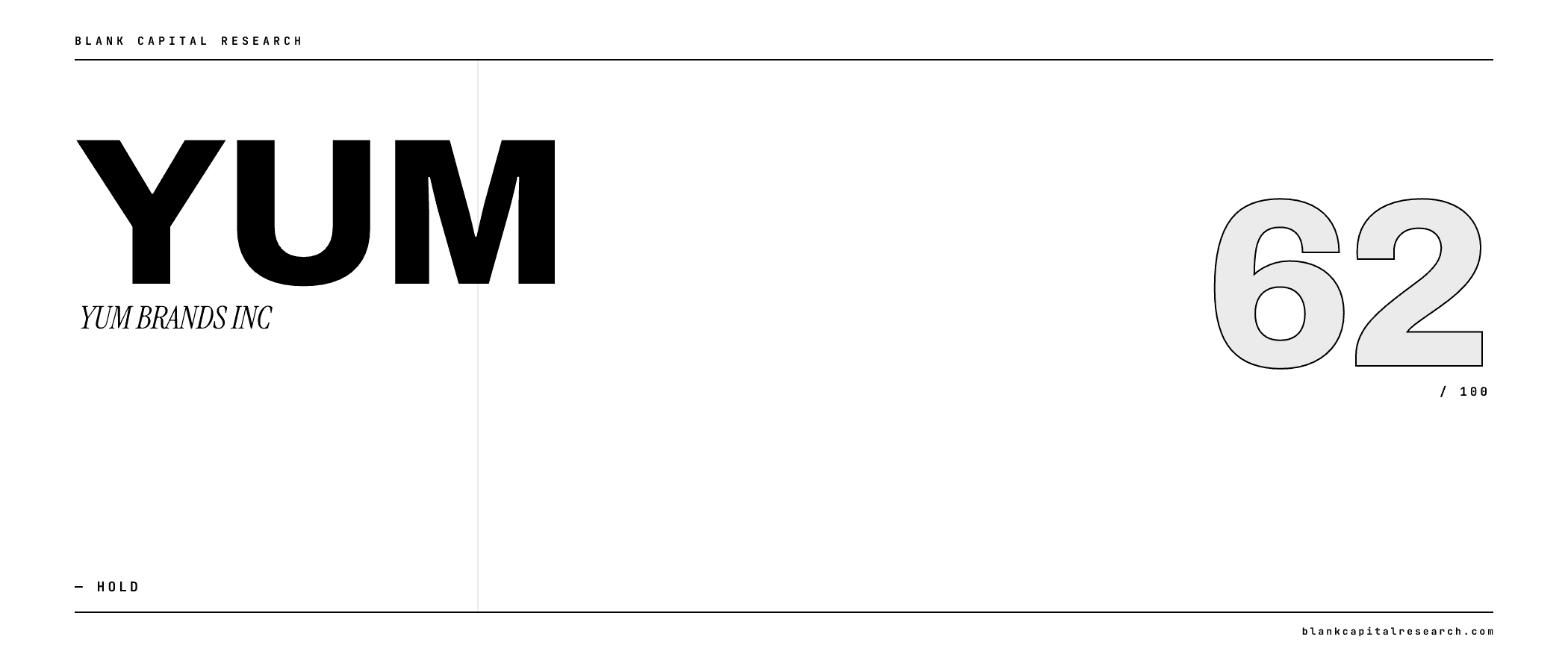
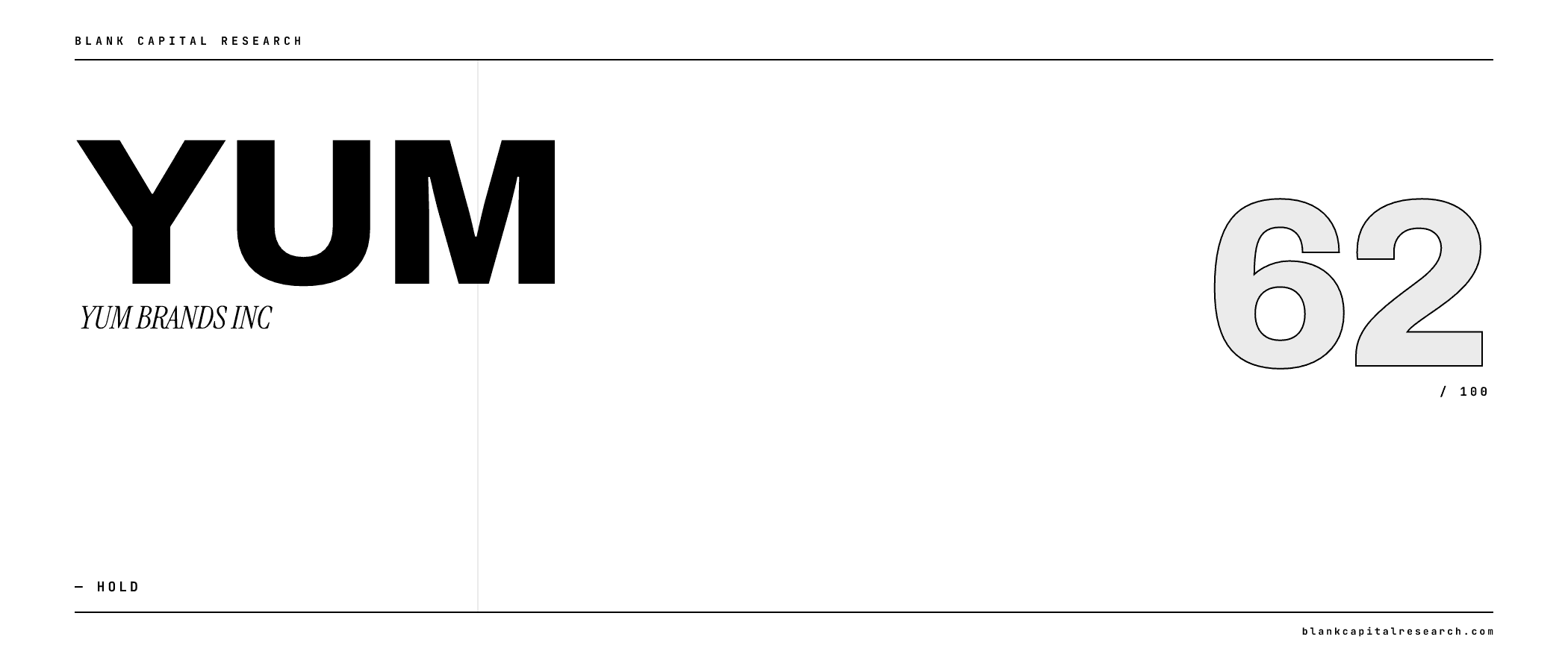
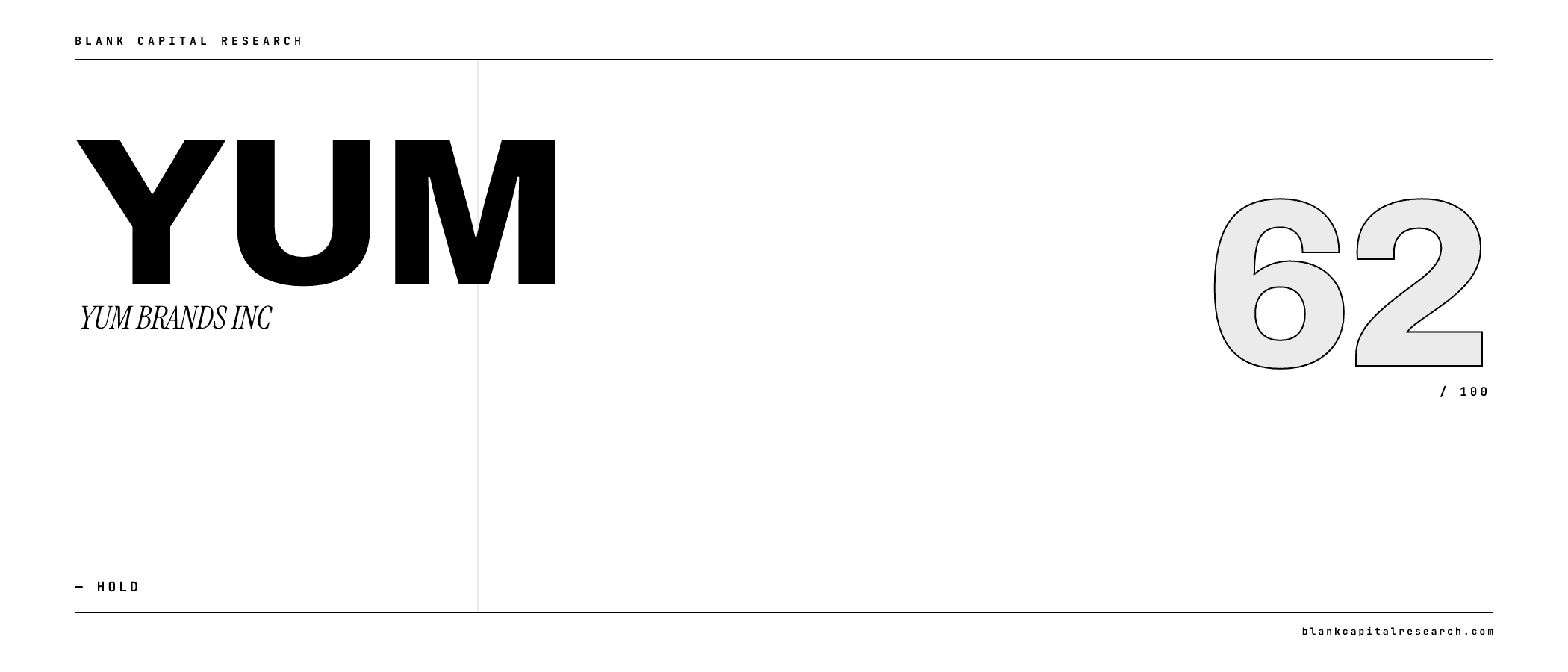
YUM BRANDS INC
YUM | Consumer Discretionary
★★★★★
80.8/100
#2
$42.6B
## Investment Thesis YUM BRANDS INC (YUM) currently ranks **#2** in our coverage universe of 3,571 U.S.-listed equities, with a composite score of **80.8/100**. This places the stock in our **"Strong Buy"** category based on our proprietary six-factor quantitative model. The bull case rests on three pillars: exceptional profitability (Quality score: 65/100), favorable market dynamics (Momentum: 76/100), and reasonable valuation relative to quality (Value: 94/100). Our model, built on 46 peer-reviewed academic studies, identifies these factor combinations as historically predictive of outperformance. The central question for investors: **Is YUM's quality premium justified by its growth trajectory, or has the market already priced in perfection?** --- ## Company Overview YUM BRANDS INC operates in the **Consumer Discretionary** sector and has demonstrated solid revenue growth of 8.4% over the trailing twelve months. The company converts 20.1% of revenue into net income, a best-in-class margin profile. At $42.6B, YUM is a large-cap stock with established market position and diversified revenue streams. --- ## Our Six-Factor Analysis Our proprietary model evaluates every stock across six factors, each backed by peer-reviewed academic research. Here's how YUM scores: ### Quality Score: 65/100 ★★★★ **What we measure:** Return on equity, return on assets, gross margin, net margin, earnings consistency, and accruals quality. YUM generates a return on equity of **-25.0%**, below average and an area for management focus. Gross margin of **68.6%** demonstrates strong pricing power and efficient operations. Net margin of **20.1%** is world-class and suggests significant competitive advantages. **Academic evidence:** Research by Novy-Marx (2013) demonstrates that quality stocks outperform by 4-6% annually over long periods, even after controlling for market beta. --- ### Value Score: 94/100 ★★★★★ **What we measure:** P/E, P/B, P/S, EV/EBITDA, and free cash flow yield relative to sector and historical norms. YUM trades at **29.42x earnings**, a premium valuation that requires continued execution. **Academic evidence:** Fama and French (1992) established that value stocks (low P/B, P/E) outperform growth stocks by 3-5% annually, though this premium has compressed in recent years. --- ### Momentum Score: 76/100 ★★★★ **What we measure:** 12-month price momentum, revenue growth acceleration, earnings surprise frequency, and relative strength. Revenue growth of **8.4%** reflects mature market conditions. Our timing model assigns a score of **57.78742850333651/100** with a **Favorable** signal, suggesting neutral timing. **Academic evidence:** Jegadeesh and Titman (1993) documented that stocks with strong 6-12 month momentum continue to outperform over the subsequent 3-12 months, generating 1%+ monthly alpha. --- ### Investment Score: 78/100 ★★★★ **What we measure:** Asset growth, capital expenditure intensity, acquisition activity, and capital allocation discipline. An investment score of 78/100 suggests YUM is deploying capital effectively to drive future growth. **Academic evidence:** Titman, Wei, and Xie (2004) found that companies with high asset growth subsequently underperform, suggesting capital discipline matters. --- ### Stability Score: 88/100 ★★★★★ **What we measure:** Beta, earnings volatility, balance sheet strength, debt levels, and cash flow consistency. Beta of **0.45** indicates lower volatility than the market. Debt-to-equity of **-1.5%** reflects a conservative capital structure with ample financial flexibility. **Academic evidence:** Low-volatility stocks have historically outperformed high-volatility stocks on a risk-adjusted basis—a phenomenon known as the "low-volatility anomaly" (Baker, Bradley, Wurgler 2011). --- ### Short Interest Score: 10/100 ★★ **What we measure:** Days to cover, short interest as percentage of float, and short interest trend. A short interest score of 10/100 suggests significant bearish positioning, which could indicate either smart money concerns or potential short squeeze opportunity. --- ## Economic Moat Assessment Based on our analysis of profitability metrics, competitive positioning, and sustainability of returns, we assess YUM's economic moat as follows:
| Moat Type | Switching Costs |
| Moat Width | Narrow |
| Uncertainty | Low |
- Revenue stability indicates potential switching costs --- ## Fair Value Estimate We employ a reverse discounted cash flow methodology to estimate fair value, working backward from the current price to determine what growth assumptions are implied. ### Three-Scenario Analysis
| Scenario | Implied Fair Value | Upside/Downside | Assumptions |
|---|---|---|---|
| Bear | $21.7B | -49.0% | Assumes 8% 5-year growth, 18x terminal P/E, 12% discount rate |
| Base | $39.6B | -7.0% | Assumes 12% 5-year growth, 25x terminal P/E, 10% discount rate |
| Bull | $68.9B | +61.7% | Assumes 18% 5-year growth, 32x terminal P/E, 9% discount rate |
### Probability-Weighted Expected Return Assuming 20% bear, 50% base, and 30% bull probability weights: **Expected Return: 5.2%** --- ## Peer Comparison How does YUM stack up against sector peers?
| Company | BCR Score | P/E | ROE | Net Margin |
|---|---|---|---|---|
| YUM (This Stock) | 80.8 | 29.42 | -25.0% | 20.1% |
| TJX | 80.6 | 30.38 | 63.5% | 9.5% |
| FAST | 79.9 | 45.88 | 33.6% | 15.7% |
| BYD | 79.9 | 3.70 | 82.4% | 1.4% |
| HAS | 79.6 | N/A | 91.0% | 16.9% |
| MCRI | 79.5 | 23.39 | 22.0% | 22.1% |
YUM scores higher than all shown peers, suggesting superior factor profile. --- ## Risk Factors Every investment carries risk. Here are the key risks for YUM: ### Valuation Risk ⚠️ HIGH The current valuation leaves limited margin of safety for execution missteps. ### Competitive Risk ⚡ MODERATE Competitive dynamics in this sector require ongoing investment and strategic adaptation. ### Execution Risk ⚡ MODERATE The company has demonstrated reasonable operational stability. ### Macro Risk ⚡ MODERATE All equities are subject to macroeconomic conditions including interest rates, inflation, and economic growth. A recession could impact earnings regardless of company-specific quality. --- ## Financial Deep Dive ### Income Statement Analysis **Gross Margin: 68.6%** — Exceptional pricing power and operational efficiency. **Operating Margin: 33.6%** — Best-in-class operational efficiency. **Net Margin: 20.1%** — World-class profitability. ### Balance Sheet Analysis **Debt-to-Equity: -1.5%** — Conservative leverage with ample financial flexibility. **Return on Equity: -25.0%** — Below-average ROE suggests capital efficiency concerns. ### Cash Flow Indicators **Revenue Growth: 8.4%** — Steady growth reflecting mature market position. --- ## Investment Decision Framework ### Who Should Buy YUM? ✅ **Long-term investors** seeking quality exposure ✅ **Factor investors** targeting quality and momentum ✅ **Portfolio builders** needing Consumer Discretionary sector exposure ### Who Should Avoid YUM? ❌ **Deep value investors** seeking bargain prices ❌ **Short-term traders** seeking high volatility ### Position Sizing Recommendation Based on our factor profile and risk assessment: | Portfolio Size | Suggested YUM Weight | |----------------|---------------------------| | $10,000 | $800 - $1,200 | | $100,000 | $8,000 - $12,000 | | $1,000,000 | $80,000 - $120,000 | --- ## The Bottom Line YUM BRANDS INC represents **a compelling investment opportunity** based on our six-factor quantitative analysis. The company's quality metrics are solid, while its valuation offers attractive entry point. Our fair value analysis suggests **downside risk of 7%** under base-case assumptions, with probability-weighted expected returns of **5%**. We recommend accumulation, particularly on any pullbacks that improve the risk-reward profile. ---
Summary Metrics
| Rating | ★★★★★ Strong Buy |
| BCR Score | 80.8/100 |
| Universe Rank | #2 of 3,571 |
| Moat Assessment | Narrow Switching Costs |
| Fair Value Estimate | $39.6B |
| Expected Return | 5.2% |
--- ## Methodology Disclosure This analysis is based on the Blank Capital Research six-factor quantitative model, which evaluates securities across Quality, Value, Momentum, Investment, Stability, and Short Interest factors. Factor weights are derived from 46 peer-reviewed academic studies and calibrated to current market conditions. Our fair value estimates employ reverse discounted cash flow analysis, working backward from market price to implied growth assumptions. This methodology is inherently uncertain and should be considered as one input among many in investment decisions. --- *This report was generated on Monday, February 16, 2026. The analysis reflects data as of that date. Past performance does not guarantee future results. This is not investment advice. Blank Capital Research may hold positions in securities mentioned.*