"Valuation is not a science. It is an art."
In the high-stakes world of capital allocation, two distinct tribes often talk past one another. On one side are the "Storytellers," or the founders and venture capitalists who spin mesmerizing visions of total addressable markets (TAM) and world-changing disruption. On the other are the "Number Crunchers"—quants and accountants who bury their heads in historical data, often missing the forest for the DCF model.
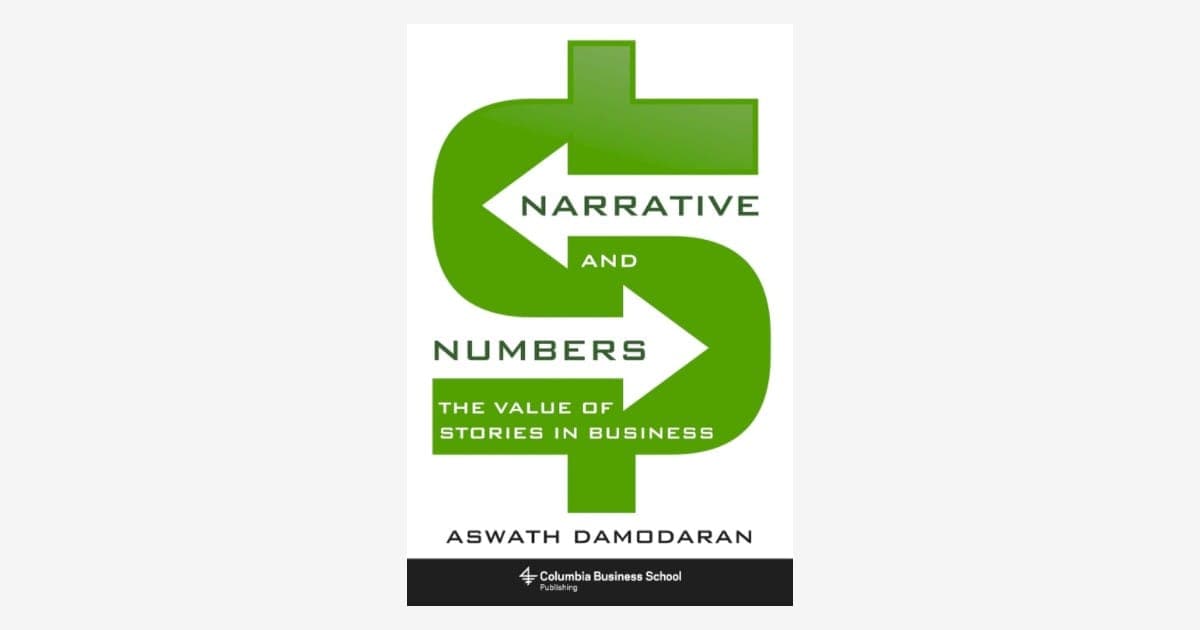
In Narrative and Numbers, Aswath Damodaran, professor of finance at NYU Stern and widely considered the "Dean of Valuation," argues that neither tribe has the full picture. True value, he contends, is found only when you force a narrative to submit to the discipline of numbers, and conversely, when you give life to a spreadsheet through a plausible story.
The Uber Disconnect
Damodaran anchors the book with his now-famous 2014 valuation of Uber. While early investors were valuing the ride-sharing startup at $17 billion (and rising) based on a narrative of "global logistics domination," Damodaran crunched the numbers based on a "global taxi service" narrative and arrived at just under $6 billion.
The public pushback he received highlights the book’s central tension: The "Big Market" Delusion. Damodaran illustrates how easy it is to justify any valuation if you tell a story about a big enough market without checking the arithmetic of market share, competition, and unit economics.
The 5-Step Process
For the forensic analyst, the most actionable section of the book is Damodaran’s five-step framework for valuation:
- Develop a narrative for the business (The Story).
- Test the narrative against history, experience, and common sense (The Reality Check).
- Convert the narrative into key drivers of value (The Translation).
- Connect the drivers to a valuation model (The Number Crunching).
- Keep the feedback loop open (The Adaptation).
Why It Matters for Investors
Damodaran serves a critical reminder that a valuation model is nothing more than a narrative expressed in numbers. If you change the story (e.g., "Peloton is a tech company" vs. "Peloton is an exercise equipment maker"), the margins, growth rates, and risk premiums in your Excel model must change drastically.
Narrative and Numbers is a warning shot against the "fantasy math" that often permeates IPOs and SPACs. For the institutional investor, it provides a rigorous framework for deconstructing pitch decks. It teaches you to ask the most dangerous question a founder can hear: "Show me exactly where this story shows up in the cash flows."
A Must Read
This is essential reading for anyone who builds or critiques financial models. Damodaran proves that while numbers give us precision, only the story gives us meaning. Without the story, you are just doing arithmetic; without the numbers, you are just writing fiction.
Transparency Disclosure: This post contains affiliate links. As an Amazon Associate, we earn from qualifying purchases.
About Aswath Damodaran
Aswath Damodaran is the Kerschner Family Chair Professor of Finance at the Stern School of Business at New York University. Often referred to as the "Dean of Valuation," he is widely renowned for his work on equity valuation, corporate finance, and investment management.
His blog, Musings on Markets, is a staple resource for Wall Street analysts, and his data sets on equity risk premiums and betas are used as industry standards globally.