About Alphabet Inc.
Alphabet Inc. provides various products and platforms in the United States, Europe, the Middle East, Africa, the Asia-Pacific, Canada, and Latin America. It operates through Google Services, Google Cloud, and Other Bets segments. The Google Services segment offers products and services, including ads, Android, Chrome, hardware, Gmail, Google Drive, Google Maps, Google Photos, Google Play, Search, and YouTube.
It is also involved in the sale of apps and in-app purchases and digital content in the Google Play store; and Fitbit wearable devices, Google Nest home products, Pixel phones, and other devices, as well as in the provision of YouTube non-advertising services. The Google Cloud segment offers infrastructure, platform, and other services; Google Workspace that include cloud-based collaboration tools for enterprises, such as Gmail, Docs, Drive, Calendar, and Meet; and other services for enterprise customers. The Other Bets segment sells health technology and internet services. The company was founded in 1998 and is headquartered in Mountain View, California.
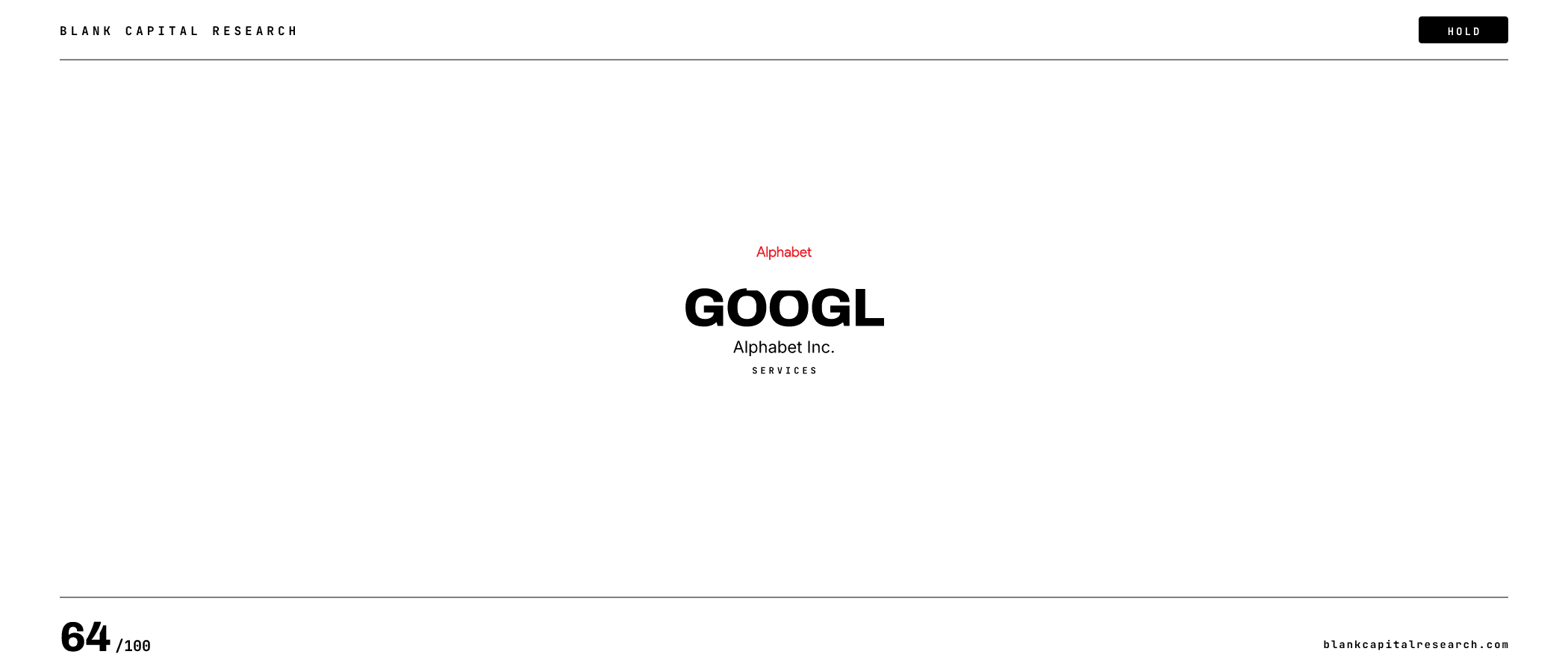
GOOGL operates in the Services | Computer Software | headquartered in MOUNTAIN VIEW, California | approximately 190,200 employees | led by CEO Sundar Pichai.
Updated February 12, 2026
Alphabet is perhaps the most analyzed company on Earth. Hundreds of sell-side analysts, thousands of institutional portfolio managers, and millions of retail investors scrutinize every earnings report, every AI announcement, every regulatory development. The idea that a quantitative model could find something the consensus has missed seems, on its face, improbable.
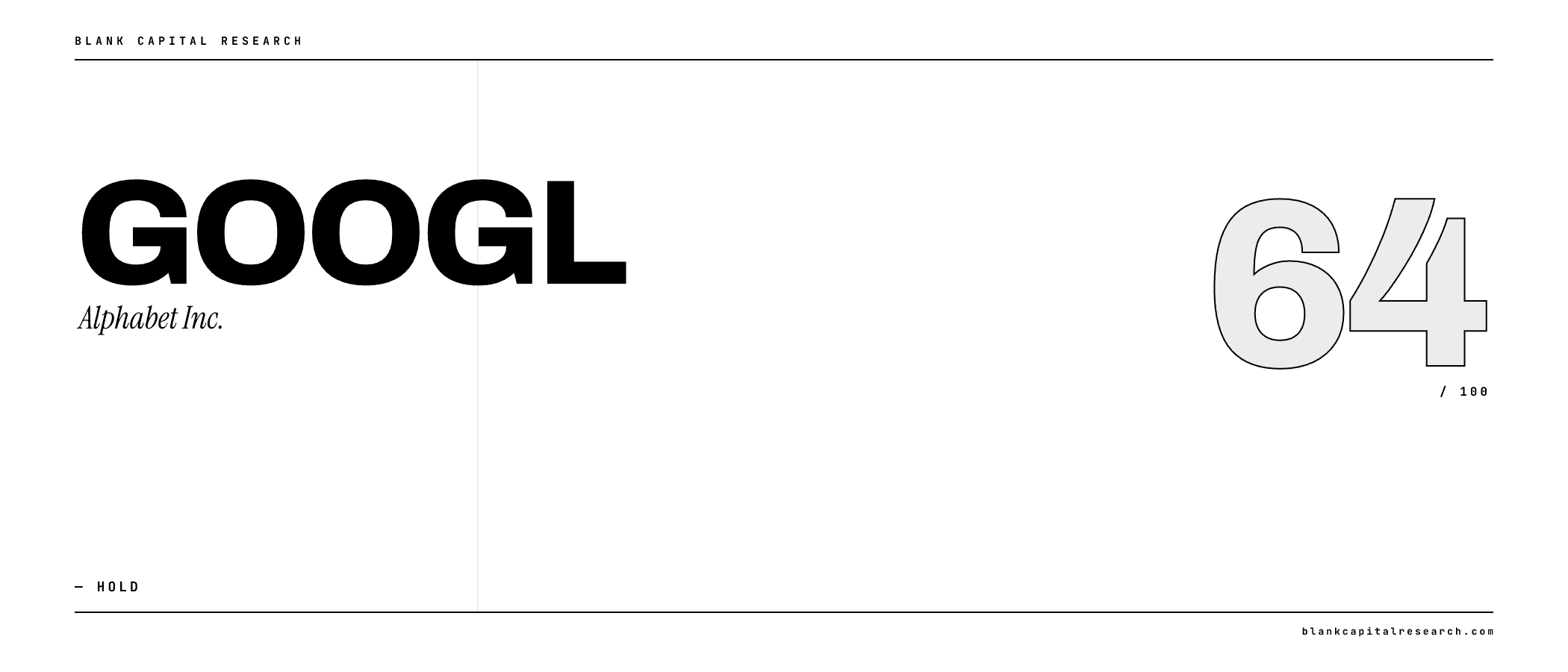
And yet here we are. Our six-factor model, which ranks 7,300 U.S. stocks on quality, value, momentum, investment efficiency, financial stability, and short interest positioning, places Alphabet at number 15 — in the top 0.2 percent of all companies. Not because it has discovered some hidden fact about Alphabet. But because it weighs the known facts differently than the market does.
The Factor Breakdown
Alphabet's composite score of 90.5 breaks down as follows:
| Factor | Score | What It Means |
|---|---|---|
| Quality | 70 | Top 30% — strong but not elite |
| Value | 57 | Roughly average — fairly priced |
| Momentum | 87 | Top 13% — strong uptrend |
| Investment | 45 | Below average — heavy spending |
| Stability | 98 | Top 2% — near-perfect |
| Short Interest | 59 | Average |
Two factors carry the weight here: stability at 98 and momentum at 87. Together they account for the lion's share of why Alphabet ranks as high as it does. This is a stock that the model sees as one of the safest, most stable holdings in the entire market — and one that is currently trending upward with strong relative momentum.
Stability: The Near-Perfect Score
A stability score of 98 means Alphabet ranks in the top 2 percent of all U.S. stocks on financial stability metrics. In a universe of 7,300 companies, only about 150 score higher.
The numbers behind that score are formidable:
- Debt-to-equity: 0.06. Alphabet carries almost no debt relative to its equity. For a company with a $2.9 trillion market capitalization, this is extraordinary. It means Alphabet could survive virtually any economic scenario without financial distress. There is no debt maturity wall, no floating-rate exposure, no covenant risk. The balance sheet is a fortress.
- Return on assets: 27 percent. Alphabet generates 27 cents of profit for every dollar of assets on its balance sheet. This is among the highest in the large-cap universe and reflects the asset-light nature of the search and advertising business.
- Gross margin: 60 percent. Six out of every ten dollars of revenue flows through to gross profit. This is lower than Microsoft (68 percent) because Alphabet's hardware operations and cloud infrastructure carry higher costs, but it is still exceptional by any standard.
The stability factor exists because of a well-documented anomaly in financial markets: low-volatility and financially stable stocks tend to deliver better risk-adjusted returns than their higher-volatility peers. This violates the textbook prediction that higher risk equals higher return — and it has been confirmed across decades of data and dozens of markets worldwide. Alphabet is a textbook beneficiary of this anomaly.
Momentum: The Market Is Voting
Alphabet's momentum score of 87 means its stock has been outperforming 87 percent of all other stocks over the relevant measurement window. For a $2.9 trillion company — where moving the stock price requires enormous capital flows — this kind of relative strength is significant.
Revenue growth of 16 percent is fueling the price trend. Cloud revenue continues to accelerate. Search advertising remains a cash machine. YouTube's ad revenue has recovered and expanded. And the market is increasingly pricing in Alphabet's AI capabilities as a growth driver rather than a threat to the core search business.
The momentum score does not know any of this. It simply measures price. But price, as the academic literature has demonstrated since Jegadeesh and Titman's 1993 paper, is one of the best predictors of future price. Stocks in the top quintile of momentum tend to continue outperforming for three to twelve months.
Quality: Good but Not Great
Alphabet's quality score of 70 puts it in the top 30 percent — solid, but not in the elite tier that you might expect from a company of this stature.
The quality factor measures profitability: margins, return on equity, return on assets, and earnings consistency. Alphabet scores well on most of these — a 30 percent ROE and 34 percent net margin are excellent by any measure. But the quality score is dragged down slightly by the operating margin of 31 percent, which, while strong, is lower than some mega-cap peers (Microsoft's is 47 percent, for example).
The difference reflects the business mix. Alphabet's "Other Bets" — Waymo, Verily, DeepMind, and other moonshot projects — are high-investment, low-return operations that compress overall margins. The core Google business is extraordinarily profitable, but the conglomerate-level metrics include the drag from these ventures.
Value: Fairly Priced, Not Cheap
At 21 times earnings, Alphabet is not expensive. But it is not cheap either. The value score of 57 means the stock sits roughly in the middle of the pack — modestly above average.
Price-to-book at 7.6 and price-to-sales at 7.2 are typical for a high-margin technology company. EV/EBITDA at 14.8 is reasonable but not compelling. The model does not see Alphabet as a value stock, and it does not pretend to. Value is the one factor that is not doing heavy lifting in this profile.
This matters because it tells you what kind of stock Alphabet is in the model's view: a stability-and-momentum play, not a value play. You own Alphabet because it is a near-indestructible business with strong price trends, not because it is cheap.
Investment Efficiency: The AI Spending Drag
Alphabet's lowest factor score is investment efficiency at 45 — below average. This is the same dynamic we see across the hyperscaler cohort (Microsoft, Amazon, Meta): massive capital expenditure on AI infrastructure that the model flags as risk.
Alphabet's CapEx has surged as it builds out data centers, develops custom TPU chips, and expands the compute capacity for Gemini and its broader AI product suite. Whether this spending generates commensurate returns is the central question of the current tech investment cycle.
The model does not answer that question. It simply notes that Alphabet is spending at a rate that exceeds historical norms, and that on a pure efficiency-of-capital basis, this spending makes the stock less attractive than it would otherwise be. The 45 score is an honest acknowledgment that Alphabet is in the investment phase of a capital cycle, and the returns on that investment remain to be proven.
Ranking 15th Among 7,300: What It Means
For a company that is covered by every analyst on the planet, ranking in the top 0.2 percent of a quantitative model is noteworthy. It does not mean the market has "missed" Alphabet — the stock is priced at $2.9 trillion precisely because investors recognize its dominance. But it does mean that, when you measure all the factors that predict stock returns and weight them according to academic research, Alphabet ends up in a very small club.
The model ranks Alphabet highly for the same reason it was originally developed: to find stocks where the combination of quality, value, momentum, and stability is stronger than any single one of those factors would suggest. Alphabet at 21 times earnings would not excite a pure value investor. Alphabet's quality metrics would not top the list for a pure quality investor. But when you put all six factors together, the full picture is more compelling than any single angle.
This is what systematic investing is designed to find. Not hidden gems — Alphabet is the opposite of hidden — but the right framework for evaluating what is already in plain sight.
Explore the full Alphabet (GOOGL) analysis including DCF valuation, risk analytics, and factor breakdown, or view the complete stock rankings.
Disclaimer: This article is for informational purposes only and does not constitute investment advice. All data is derived from Blank Capital's quantitative ranking model. Past performance does not guarantee future results.